If you run a growing company in India — manufacturing in Pune, services in Mumbai, tech in Bengaluru — you have probably seen the same HRMS pitch: a slide deck with payroll, recruitment, AI copilots, and “full-suite transformation.” The demo looks complete. Six months later, your team is still maintaining leave balances in Excel and chasing approvals on WhatsApp.
The gap is not always vendor dishonesty. It is a mismatch between what Indian SMEs need first and what enterprise HR suites are built to sell. Global products are priced and packaged for headcount, modules, and upsell paths — not for a 120-person firm that needs one reliable system of record before it needs statutory payroll automation.
We build NoviManager HRMS for organizations in that middle ground: past spreadsheets, not ready for a multi-year enterprise rollout. This guide is written for founders, HR leads, and IT managers evaluating HR software in India — whether or not you ever speak to us.
How Indian SMEs actually run HR today
Before comparing vendors, name the reality most RFPs skip:
- Employee records split across Excel, onboarding PDFs, and someone’s personal folder
- Leave requested by email or WhatsApp, approved from memory, rarely audited
- Documents — offer letters, policies, ID proofs — on shared drives with inconsistent access
- Managers without a single queue for pending actions
- Employees asking HR the same policy questions every quarter
None of that requires predictive attrition models on day one. It requires connected workflows, clear permissions, and a directory everyone trusts. Until that exists, every additional module is a layer on top of chaos.
Day-one HRMS: the non-negotiables for Indian SMEs
When we say “day one,” we mean the scope that should work in your first production month — not a three-year roadmap. For most SMEs in India, that includes:
1. Employee directory and profiles
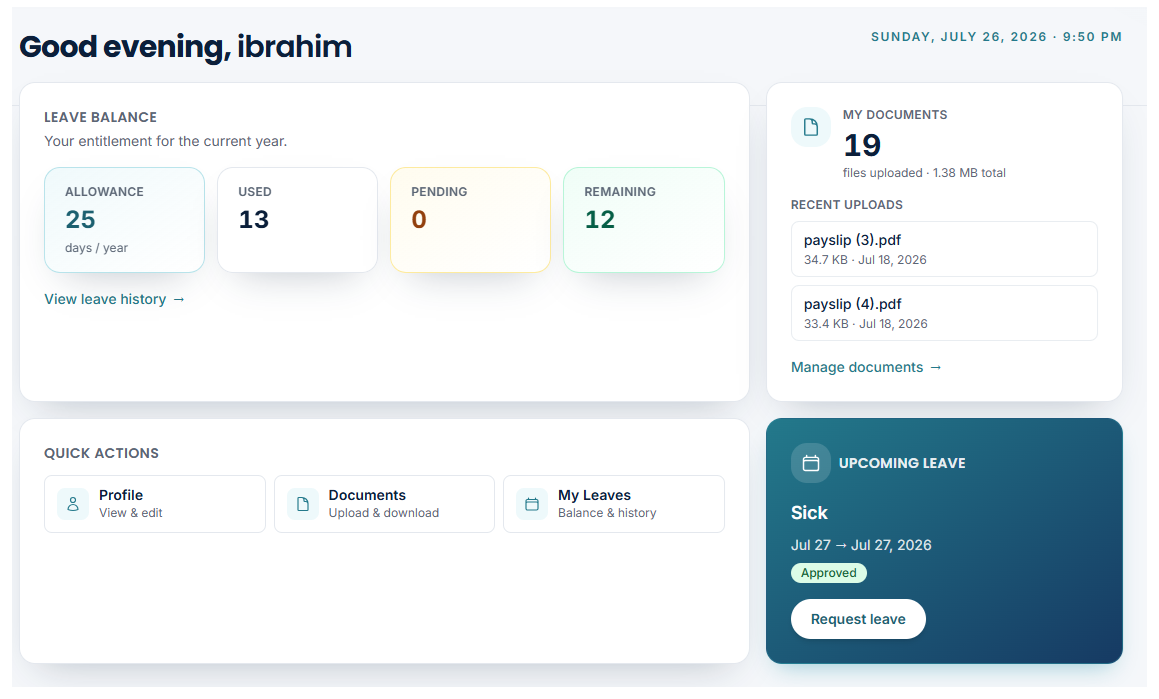
One record per person: department, role, reporting line, join date, contact details, employment status. Admins maintain it; employees update safe fields themselves. Without this, leave balances and approvals attach to the wrong person — a common failure mode when teams skip straight to “attendance machines” or payroll.
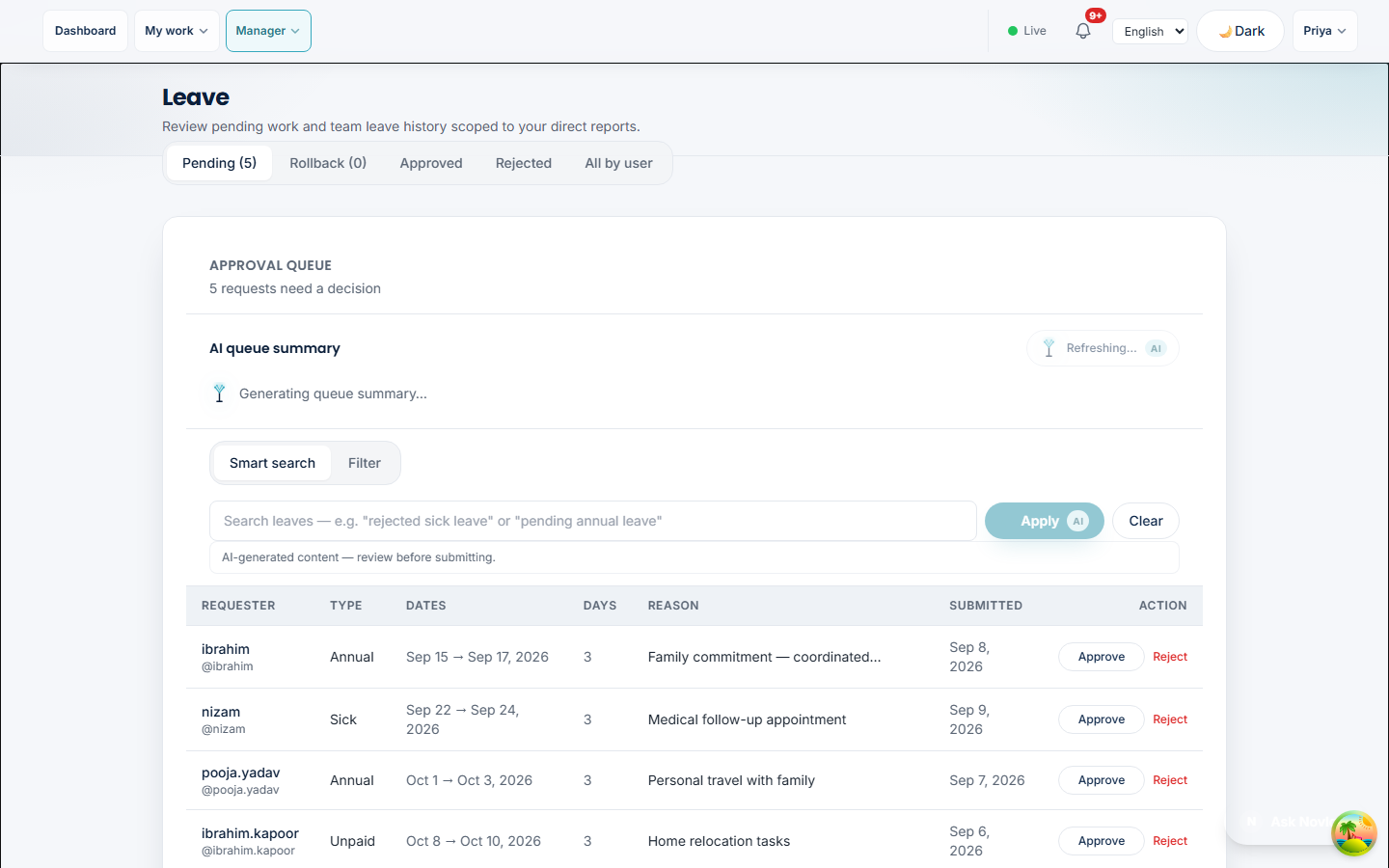
2. Leave management with manager approval
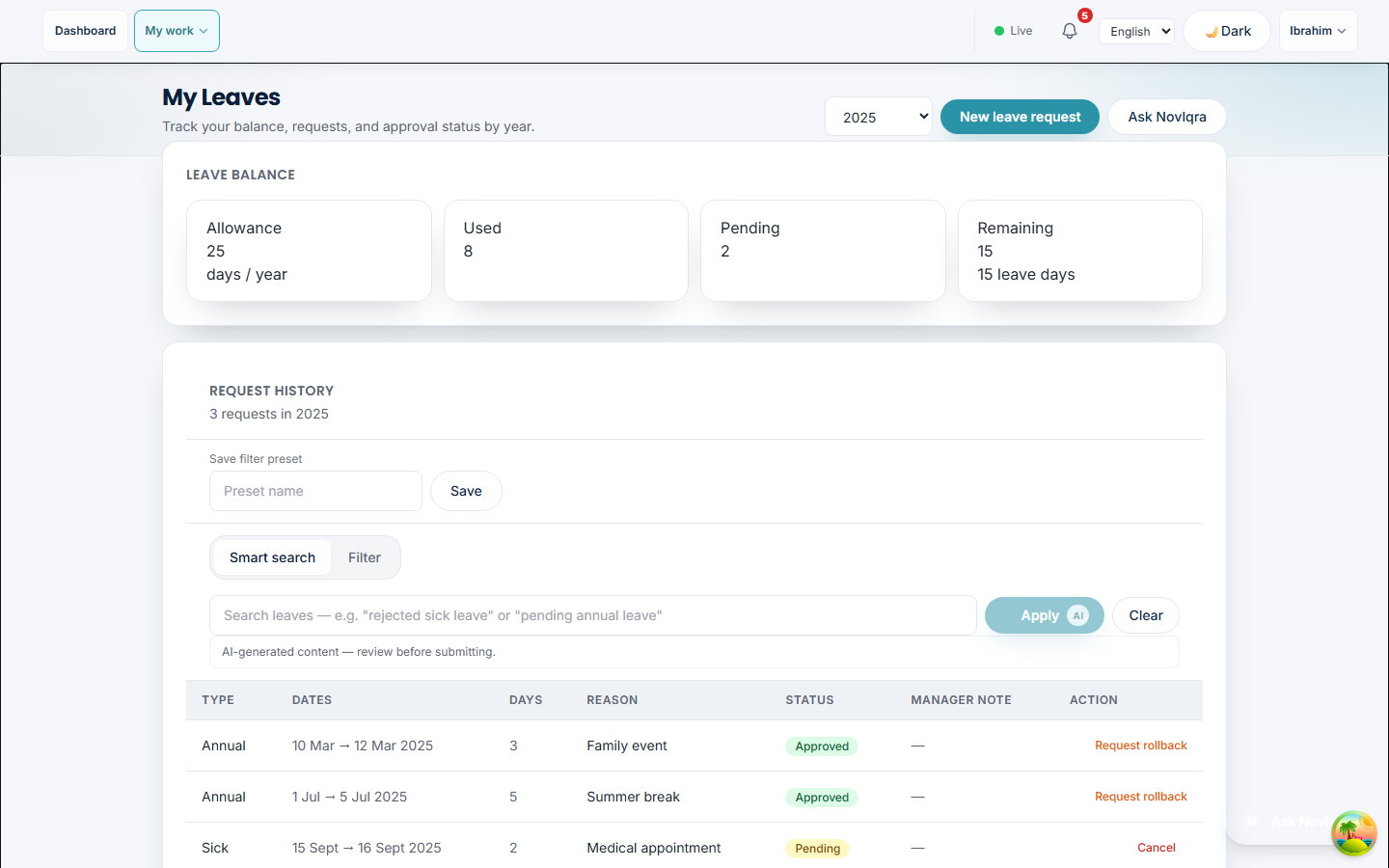
Balances, business-day calculation, request history, and a manager approve/reject path with an optional note. In India, leave types and carry-forward rules vary by policy; the system must reflect your handbook, not a generic template. Email and WhatsApp approvals do not scale past one location or one busy manager.
3. Role-based access — employee, manager, admin
Employees see their data. Managers see their team. HR and admins govern the org. This is not an enterprise luxury; it is how you stop salary details and documents leaking through a single shared login — a pattern we still see in mid-size Indian firms.
4. Document management with control
Policy PDFs, employee uploads, department folders, and admin oversight. Shared Google Drive or network folders work until someone deletes the wrong file or ex-employees retain links. HRMS document modules do not need to rival a full ECM on day one — they need folder structure, permissions, and an audit trail on sensitive admin actions.
5. Mobile-friendly access
Managers approve from phones. Employees check balances on the way to work. A responsive web app or installable progressive web app (PWA) is enough for most SMEs; a native app store launch can wait. What cannot wait is a UI that works on a 6-inch screen without horizontal scrolling.
6. Search that admins will actually use
“Show me active employees in Engineering hired after 2024” should not require exporting to Excel. Natural-language or smart directory search saves HR hours weekly once headcount passes a few dozen.
What vendors often sell on day one (and why it waits)
These capabilities appear early in demos and contracts. They matter — often a lot — but usually after core HR runs in one system:
- Payroll and statutory compliance — PF, ESI, TDS, payslips. Essential at scale; heavy to implement before employee master data is clean. Many SMEs keep payroll with a specialist provider while fixing HR operations first.
- Recruitment and applicant tracking — valuable when hiring is constant; low daily use for stable headcount.
- Full performance management suites — 360 reviews, calibration, compensation bands — built for enterprises with dedicated HRBPs.
- Learning management (LMS) — often a separate product integrated loosely.
- Generic AI copilots — impressive in sales; weak if directory and leave still live outside the platform. (We wrote separately about AI patterns that earn their place in HRMS.)
- Global compliance packs — multi-country, multi-entity — irrelevant for a single-entity Indian SME.
- Advanced workforce analytics — attrition prediction, engagement indices — leadership nice-to-haves, not operational fixes.
Buying these upfront increases cost, lengthens implementation, and trains the organization to see HRMS as a project — not a daily tool. Vendors benefit from module count; your team benefits from adoption on the workflows they touch every week.
Side-by-side: day-one needs vs typical vendor packaging
Use this table in internal discussions or vendor comparisons. “Day one” means first productive month; “often bundled early” reflects common Indian and global HRMS sales motion.
| Capability | Day-one priority for SMEs | Often sold upfront |
|---|---|---|
| Employee directory & org structure | Essential | Included (but sometimes bare-bones) |
| Leave requests & manager approvals | Essential | Included |
| Self-service profile & documents | Essential | Sometimes add-on |
| Mobile / PWA access | Essential | Often underplayed in demos |
| Admin audit on sensitive actions | High | Enterprise tier only |
| Payroll & statutory filing | Later (or separate vendor) | Heavily featured in pitch |
| Recruitment / ATS | Later | Often bundled |
| AI assistant / copilot | After core HR works | Featured prominently |
| Multi-entity / global HR | Rare for SMEs | Suite differentiator |
Indian context: what “local” really means
Buyers in India rightly ask about local support, data residency, and familiarity with how teams work. Clarify what each vendor means:
- Statutory payroll is local; leave approval workflow is universal but must match your policy
- Hindi or regional language UI helps adoption; English-only is still common in many SMEs
- Implementation partner in India matters more than a global brand logo
- Data location — Azure India regions, on-prem, or customer VPC — should be explicit in the contract
- Support hours aligned to IST, not only US or EU follow-the-sun
“Local HRMS” is not a magic label. It is support, deployment choice, and workflows that match how your managers already decide — with a system that records the decision.
Signs you are ready for HRMS (and signs you are not)
Ready
- HR spends hours reconciling leave balances or chasing approvals
- Two departments maintain different employee lists
- Managers ask for “who reports to whom” more than once a month
- Document access after offboarding is a known risk
- You are hiring steadily and onboarding is inconsistent
Not yet (or start smaller)
- Under ~25 employees with informal culture that still works
- No one owns HR data quality — HRMS will not assign an owner for you
- You want payroll fixed tomorrow but will not pause to clean employee records
- Leadership expects “digital transformation” without managers using the system weekly
How to evaluate vendors without the upsell trap
Structure the evaluation around day-one workflows, not slide count:
- Ask for a day-one scope document — what is live in month one, not year two.
- Run three scripted scenarios — employee requests leave, manager approves on mobile, admin finds an employee via search and views documents.
- Price the modules you will not use in year one — subtract them mentally from ROI.
- Check offboarding — access revoked, documents retained, audit visible.
- Pilot with one department — validate adoption before org-wide rollout. A structured 30-day pilot with written scope beats a rushed “go live.”
- Confirm the platform works if you disable AI — core HR must stand alone.
What a complete platform looks like before payroll
A complete HRMS for SMEs does not mean “every module ever built.” It means the operational core is production-ready: directory, leave lifecycle, manager operations, documents, time and attendance if you track hours, reviews if you run cycles, help desk if employees escalate HR issues, and admin oversight — in one sign-in, with permissions throughout.
That is the scope we ship in NoviManager: a progressive web app for mobile and desktop, resumable document uploads for large policy files, Smart Search on the directory, Ask NovIqra for workforce questions from live data, and a structured 30-day pilot programme for qualified organizations — platform licensing complimentary during evaluation, annual licensing quoted before you commit.
We are not arguing against payroll or recruitment forever. We are arguing for sequence: fix the system of record and daily workflows first; add statutory payroll when master data and approvals are trustworthy.
Summary
Indian SMEs do not fail at HRMS because they chose the wrong algorithm. They fail because they bought a suite narrative before they had a directory, leave path, and manager queue that people use every week. Day one is unglamorous — records, approvals, documents, mobile access, and search. Everything else is expansion, not foundation.
When you talk to vendors, ask which side of that line each module sits on. Your team will thank you when the first month feels quieter — not when the contract lists fifteen modules nobody opened.
Frequently asked questions
What HRMS features do Indian SMEs need on day one?
Employee directory, self-service profiles, leave with manager approval, controlled document storage, role-based dashboards, and mobile access — before payroll, recruitment, or advanced analytics.
What do vendors often sell too early?
Payroll packs, ATS, enterprise performance suites, generic AI copilots, and global compliance modules — valuable later, distracting when core HR still lives in spreadsheets.
How many employees justify HRMS in India?
Often 30–50+, depending on locations, managers, and audit expectations — but pain matters more than headcount alone.
Cloud or on-premise for Indian SMEs?
Cloud is common for speed; on-prem suits strict residency or existing IT. Choose after day-one scope is clear — not before.